
Search for how much does it cost to build a SaaS app and you’ll get answers ranging from $5,000 to $500,000. Annoying, right? The thing is, both numbers can be true. A simple subscription tool and a multi-clinic healthcare platform are just very different animals, and they’re priced that way.
We build SaaS products at AiZenty, mostly on Laravel and Next.js, so the ranges below reflect how these projects usually go for a small, focused team. Your own quote will land somewhere different, and that’s fine. The goal here is simpler: you should know what’s reasonable before you start talking to agencies.
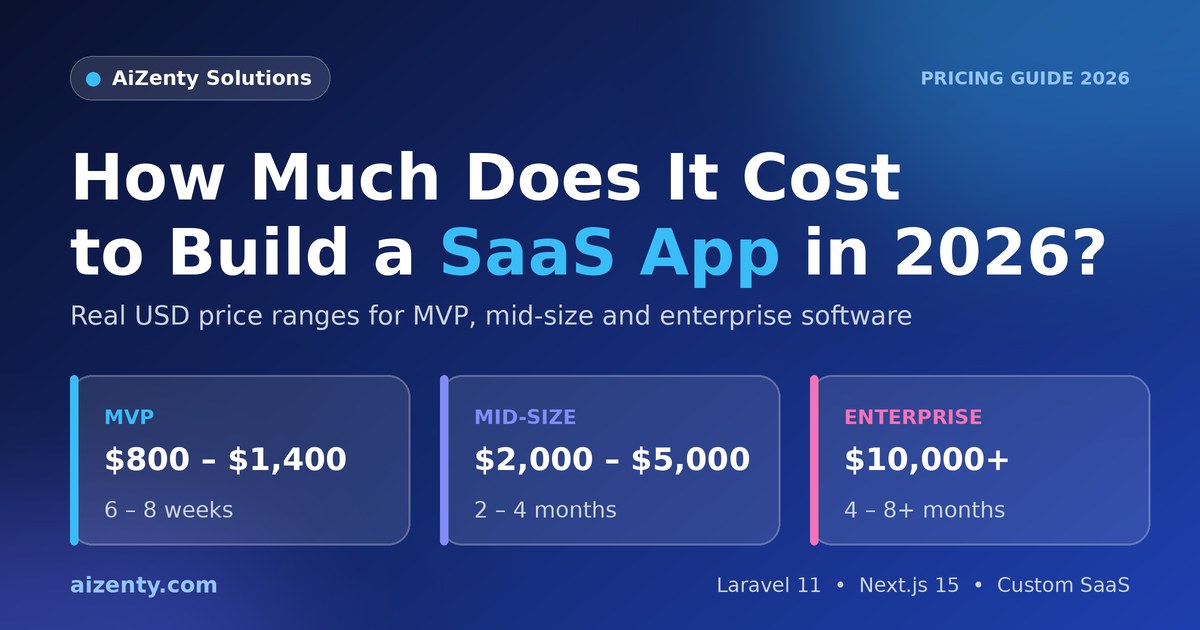
The Quick Numbers: SaaS Development Cost in 2026
| Product Stage | Typical Cost (USD) | Typical Timeline |
|---|---|---|
| MVP (Minimum Viable Product) | $800 – $1,400 | 6 – 8 weeks |
| Mid-Size SaaS Platform | $2,000 – $5,000 | around 2 to 4 months |
| Enterprise SaaS Platform | $10,000 and up, depending on customization | 4 to 8 months, sometimes longer |
Think of the MVP as version one with the training wheels still on. Mid-size is what you grow into once people are actually paying you and asking for more. Enterprise? Different story. The price there mostly comes down to how much custom work your client wants.
Launch small. Let your first paying customers tell you what’s missing.
Why Two Similar Apps Can Cost Wildly Different Amounts
Two founders can both say “I want a project management tool” and receive quotes thousands of dollars apart. The idea isn’t what changes the price. The details are.
Features
This one’s obvious but people still underestimate it. Every feature needs design, development, testing and later, maintenance. Five well-chosen features will almost always beat twenty half-used ones, and they’ll cost far less.
Design
Template-based design is fast and cheap. Custom animations, hand-drawn illustrations, three separate dashboards for three types of users? That’s weeks of extra work. Early on, nobody walks away because your buttons aren’t fancy. Keep it clean and move on.
Integrations
Almost every SaaS app ends up connecting to something else. Stripe takes the payments, SendGrid sends the emails, Twilio handles texts, and a CRM like HubSpot might sit off to the side. Sounds easy, but each of those links needs testing and a plan for when it breaks (and eventually, it will). So yes, the price goes up with every tool you add.
Compliance
Selling to hospitals, banks or big US companies? You’ll probably need HIPAA, SOC 2 or GDPR readiness. That means extra work on access control, logging and data protection. It’s one of the main reasons enterprise projects cost more.
Speed
Need it by next month? Then the team has to work in parallel, and rushing always costs extra. If your launch date can move, building in phases is a cheap way to save money.
What You Actually Get at Each Level
MVP Development Cost: $800 – $1,400
Expect sign-up and login, one or two core features, a basic admin area, Stripe subscriptions and a layout that works on phones. That’s about it. No fancy reports, no ten integrations. Six to eight weeks is normal.
Some founders feel this is too small to launch. It isn’t. An MVP has one job: answer the question “will anyone pay for this?” You’d rather find out after spending a little than after spending a lot.
Mid-Size SaaS Platform: $2,000 – $5,000
By now you’ve got paying users, and they’re asking for things. Team accounts, say. Or reports. Or a way to sync with whatever accounting software they already use. That’s what this tier is for: smarter roles and permissions, analytics dashboards, a few integrations, a multi-tenant setup, plus tighter security and more testing. Give it two to four months.
Enterprise SaaS Platform: $10,000 and Up
Big companies grill you before they sign. Single sign-on? Audit logs? Where exactly is our data stored? Saying yes to all of that isn’t a quick job, which is why enterprise work starts at $10,000 and keeps climbing as the customizations pile up. Think SSO, audit trails, SOC 2 or HIPAA readiness, disaster recovery, custom APIs. Every project is different here, so don’t trust a number until you’ve seen a written quote based on what you actually need.
Three Quick Examples
Here are three examples. I made them up, but they’re close to how real projects tend to look.
A booking tool for salons. Say you want login, a calendar, email reminders and Stripe for payments. That’s a textbook MVP: roughly $1,000 to $1,400 and six to eight weeks. You launch, watch how the first few customers actually use it, and only then decide what to build next.
A client portal for an agency. A small agency wants its clients to log in and check project updates, with team roles, a reporting dashboard and a link to their accounting software. That’s a mid-size job, about $3,000 to $5,000 spread over a few months. Not cheap, but it replaces a pile of emails and spreadsheets.
A platform for a few health clinics. Every clinic needs its own private data and custom permissions, with HIPAA-aware practices throughout. This is enterprise territory. Figure $10,000 as the starting point, then add more for every requirement you pile on.
Feature-by-Feature Price Guide
If you’re building piece by piece, these ranges give you a sense of what common components cost:
| Feature | Estimated Cost (USD) |
|---|---|
| Authentication and user roles | $80 – $200 |
| Subscription billing (Stripe) | $120 – $300 |
| Admin dashboard | $150 – $400 |
| Multi-tenant architecture | $300 – $1,000 |
| Analytics and reporting | $250 – $800 |
| Each third-party integration | $100 – $400 |
| Email and notification system | $80 – $250 |
| AI-powered features (chatbot, recommendations) | $400 – $3,000 |
| Mobile app (iOS and Android) | $1,500 – $5,000 |
| Compliance work (SOC 2, HIPAA) | $1,000 – $5,000+ |
Notice how fast the total grows if you say yes to everything. That’s exactly why we push clients to launch with the essentials.
Where Your Developers Live Changes the Price (A Lot)
| Region | Typical Hourly Rate (USD) |
|---|---|
| United States and Canada | $100 – $200 |
| Western Europe | $70 – $150 |
| Eastern Europe | $40 – $90 |
| South Asia (Pakistan, India) | $5 – $15 |
Yes, that gap is real. An in-house US team gives you total control, but salaries, benefits and hiring time make it the most expensive route. Freelancers are cheaper, though quality swings wildly and you end up managing everything yourself. An offshore software development company sits in the middle: an experienced team, a defined process and much lower rates.
But don’t pick on rate alone. A cheap team that needs everything redone costs more than a solid team that gets it right the first time. Check their portfolio, talk to the actual developers, and make sure you get at least a few hours of working-time overlap.
The stack matters too. Laravel and Next.js are a popular pairing for startups because Laravel handles the backend heavy lifting (auth, queues, APIs) while Next.js gives you a fast, search-friendly frontend. Both have big communities, so finding developers later isn’t a headache. That keeps custom web application development costs sensible.
The Costs Nobody Warns You About
Launch day isn’t the finish line. It’s when a second set of bills starts arriving.
Hosting. Cloud services like AWS, Google Cloud or DigitalOcean usually run $10 to $200+ per month at the start, and grow with your traffic.
Maintenance. Budget around 15% to 20% of the original build cost per year. Bugs, security patches and small improvements all live here. Skip it and your software slowly gets slower, buggier and less safe.
Third-party tools. Payment processing, email, SMS, error tracking. Each charges a little, and together they add up.
Marketing. A great product nobody knows about is still a failed product. Plenty of founders end up spending as much on growth as on development.
Legal stuff. Terms of service, a privacy policy, maybe a security review if you sell to bigger companies.
Mistakes That Make SaaS Projects Cost More
The first is building everything at once. It feels thorough, but it’s how budgets double. The second is a vague scope: if you can’t describe a feature clearly, the team can’t price it clearly, and you’ll pay for the confusion later. The third is picking purely on price. And the fourth is forgetting about life after launch, when real users find real bugs.
There’s a fifth that gets less attention: skipping testing to save a few hundred dollars. Bugs caught during development are cheap. The same bugs caught by angry customers are not.
How to Spend Less Without Cutting Corners
Start with an MVP and let customers tell you what to build next. Use proven pieces instead of reinventing them: Stripe for billing, SendGrid for email, a tested framework for login. Release in phases. Write the scope down. And get code ownership and documentation in writing, so you’re never stuck with one vendor.
Many projects work well with a fixed price for the MVP, then a monthly arrangement for ongoing work. You get certainty at the start and flexibility once feedback rolls in.
How to Pick a SaaS Development Company
Ask to see live SaaS projects, not just mockups. Ask whether you’ll talk to the developers directly or only to an account manager. Ask who owns the code when it’s done, what the testing and deployment process looks like, and what support costs after launch. If you’re a US-based client, ask about time zone overlap too.
A good SaaS development company answers all of this plainly and puts it in writing. If they dodge, that tells you plenty.
Frequently Asked Questions
How much does it cost to build a SaaS app from scratch?
A lean MVP can run $800 to $1,400. A mid-size platform lands between $2,000 and $5,000. Enterprise projects start at $10,000 and rise with customizations.
How long does it take to build a SaaS product?
About 6 to 8 weeks for an MVP, 2 to 4 months for a mid-size platform, and 4 to 8 months or more for enterprise.
Is an offshore team really cheaper?
Usually, yes. Hourly rates in South Asia are much lower than in the US. The savings only hold up if the team communicates well and delivers clean work.
What does it cost to run a SaaS app after launch?
Hosting, third-party services and maintenance. A common rule is 15% to 20% of the build cost per year for upkeep, plus monthly infrastructure fees.
Can I skip developers and use no-code tools?
For a quick prototype, sure. For something secure, scalable and customizable, custom SaaS development tends to pay off over time.
What’s the cheapest way to get started?
Build a focused MVP, use existing tools wherever you can, and launch fast so real customers can guide the next step.
Will I own the code?
You should. Get full source code ownership, repository access and documentation written into the agreement.
Wrapping Up
So, how much does it cost to build a SaaS app in 2026? For most startups: about $800 to $1,400 for an MVP, $2,000 to $5,000 for a mid-size platform, and $10,000 and up for enterprise work with heavy customization. The cheapest quote isn’t the goal. A clear scope, a capable team and a quick route to paying customers are.
At AiZenty Solutions, we build production-ready SaaS platforms with Laravel 11 and Next.js 15, full code ownership and direct access to the developers. Got an idea and want a straight answer on price? We’re happy to talk.
Want a cost estimate for your idea? Request a free custom proposal or browse our client portfolio to see what we’ve built.